Introduction
The Aotearoa New Zealand CKM Guidance Group has identified an urgent need for new, detailed national guidance on obesity and weight management. This section provides interim guidance until that new national guidance is available.
Definition of overweight, obesity and excess adiposity
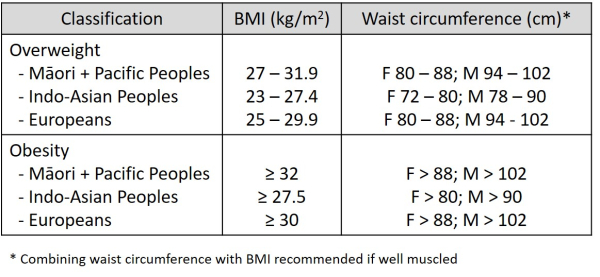
- Definitions of overweight and obesity were traditionally defined by BMI or waist circumference (WC) by sex and by ethnicity
-
Although BMI is an effective screening tool, there is now a new international consensus definition of obesity due to the limitations of BMI identifying excess adiposity at the individual level when the BMI is < 40 kg/m2. The new international definition of excess adiposity and obesity is:
- BMI > 40 kg/m2 OR
-
BMI > ethnicity-specific threshold AND ≥ 1 anthropometric criteria OR
- > 35 kg/m2 in Pacific Peoples
- > 32 kg/m2 in Māori
- > 30 kg/m2 in Europeans
- > 25 kg/m2 in Indo-Asian Peoples
- NB: Threshold is based on predominant ethnicity
- ≥ 2 anthropometric measures regardless of BMI
-
Anthropometric features of increased risk are:
-
Waist:height ratio > 0.5
- Likely most pragmatic as easily performed and not ethnicity- or sex-specific
- Waist:hip ratio > 0.86 in women and > 1 in men
-
Waist circumference:
- Non Indo-Asian ethnicity > 88 cm in women; >102 cm in men
- Indo-Asian ethnicity > 80 cm in women; > 90 cm in men
- Body fat percentage by DEXA or bioimpedance > 30% for men and > 42% for women
-
Waist:height ratio > 0.5
-
Excess adiposity is now also defined as either being preclinical or clinical obesity, to identify those greatest at risk and to enable targeted and prioritised interventions.
-
Preclinical obesity is defined as excess adiposity with preserved function of other tissues and organs.
- The term healthy obesity should no longer be used given the high lifelong risk of developing clinical obesity
-
Clinical obesity is defined as excess adiposity impacting the function of tissues, organs and the entire individual.
-
Impacted function may be due to CKM and/or non-CKM conditions
-
CKM conditions include:
- Cardiovascular disease
- Chronic kidney disease
- Elevated blood pressure and hypertension
- Type 2 diabetes
- Dyslipidaemia
- Gout
- Metabolic dysfunction-associated steatotic liver disease
-
Non CKM conditions include:
- Joint pain and osteoarthritis
- Reduced age-adjusted mobility
- Lymphoedema
- Idiopathic intracranial hypertension (or raised intracranial pressure without space-occupying brain lesion)
- Obstructive sleep apnoea
-
CKM conditions include:
-
Impacted function may be due to CKM and/or non-CKM conditions
-
Preclinical obesity is defined as excess adiposity with preserved function of other tissues and organs.